Triangles | Activity

Question 4

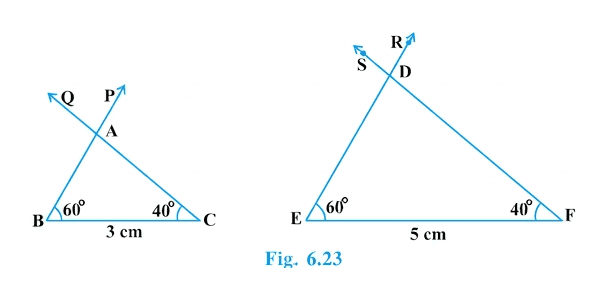
Draw two line segments BCBC and EFEF of two different lengths, say 3 cm3\text{ cm} and 5 cm5\text{ cm} respectively. Then, at the points BB and CC respectively, construct angles ∠PBC\angle PBC and ∠QCB\angle QCB of some measures, say, 60∘60^\circ and 40∘40^\circ. Also, at the points EE and FF, construct angles ∠REF\angle REF and ∠SFE\angle SFE of 60∘60^\circ and 40∘40^\circ respectively (see Fig. 6.23).

Question diagram 1
Check your answer with HomiSolve it yourself, then let Homi check your steps and spot mistakes.
Solution
Understand the Question
  • The sum of all interior angles in any triangle is always 180∘180^\circ.
  • When constructing triangles given two angles, the third angle is uniquely determined by the angle sum property.
  • AAA Similarity Criterion: If corresponding angles of two triangles are equal, the triangles are similar.
  • For two triangles to be congruent, their corresponding side lengths must also be equal.

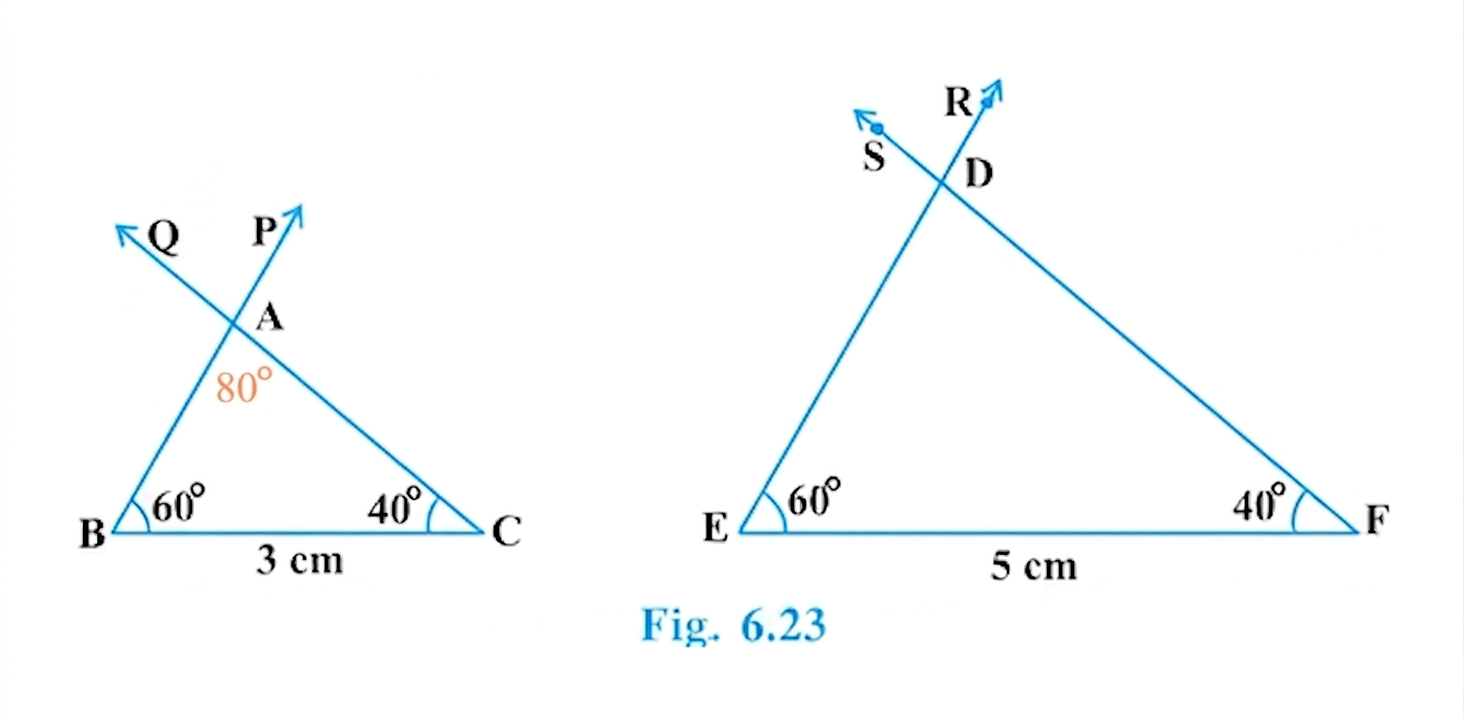
Step 1 · Find ∠A\angle A in △ABC\triangle ABC

In △ABC\triangle ABC, ∠B=60∘\angle B = 60^\circ and ∠C=40∘\angle C = 40^\circ.Diagram 1

By the angle sum property of a triangle

∠A+∠B+∠C=180∘∠A+60∘+40∘=180∘∠A+100∘=180∘∠A=180∘−100∘=80∘\begin{aligned} \angle A + \angle B + \angle C &= 180^\circ \\ \angle A + 60^\circ + 40^\circ &= 180^\circ \\ \angle A + 100^\circ &= 180^\circ \\ \angle A &= 180^\circ - 100^\circ = 80^\circ \end{aligned}

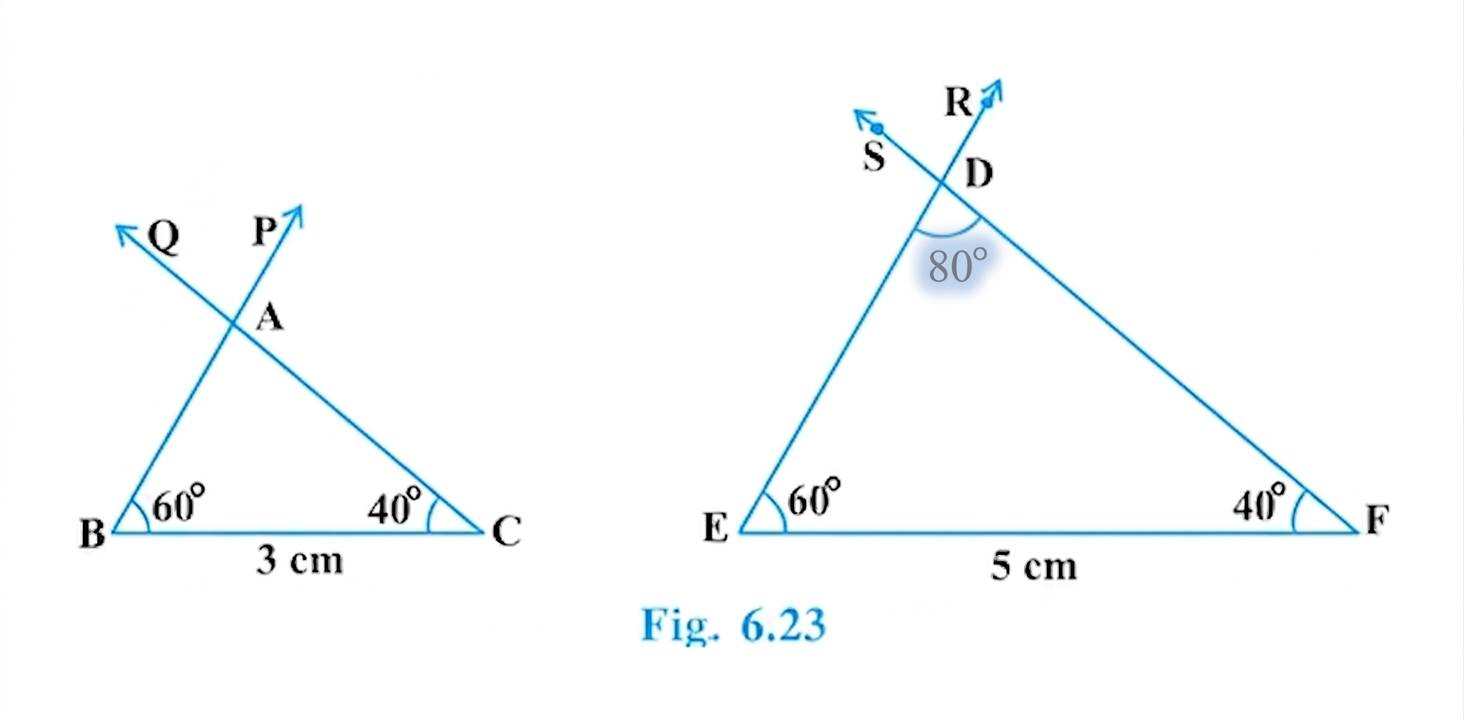
Step 2 · Find ∠D\angle D in △DEF\triangle DEF

In △DEF\triangle DEF, ∠E=60∘\angle E = 60^\circ and ∠F=40∘\angle F = 40^\circ.Diagram 2

By the angle sum property of a triangle

∠D+∠E+∠F=180∘∠D+60∘+40∘=180∘∠D+100∘=180∘∠D=180∘−100∘=80∘\begin{aligned} \angle D + \angle E + \angle F &= 180^\circ \\ \angle D + 60^\circ + 40^\circ &= 180^\circ \\ \angle D + 100^\circ &= 180^\circ \\ \angle D &= 180^\circ - 100^\circ = 80^\circ \end{aligned}

Step 3 · Compare the Triangles

Comparing △ABC\triangle ABC and △DEF\triangle DEF:

  • Corresponding angles are equal: ∠A=∠D=80∘\angle A = \angle D = 80^\circ, ∠B=∠E=60∘\angle B = \angle E = 60^\circ, and ∠C=∠F=40∘\angle C = \angle F = 40^\circ.
  • By the AAA similarity criterion, △ABC∼△DEF\triangle ABC \sim \triangle DEF.
  • Since corresponding sides have different lengths (BC=3 cm≠EF=5 cmBC = 3\text{ cm} \neq EF = 5\text{ cm}), the triangles are not congruent.
Answer

∠A=80∘\angle A = 80^\circ and ∠D=80∘\angle D = 80^\circ. The triangles △ABC\triangle ABC and △DEF\triangle DEF are similar, but not congruent.

Common Mistakes
  • Confusing Similarity with Congruence: Having all three corresponding angles equal (AAA) guarantees similarity, not congruence. Equal side lengths are necessary for congruence.
  • Angle Sum Errors: Making arithmetic mistakes when calculating the third angle from 180∘−(∠B+∠C)180^\circ - (\angle B + \angle C).
← Back to Triangles