Circles | Exercise 10.2

Question 12

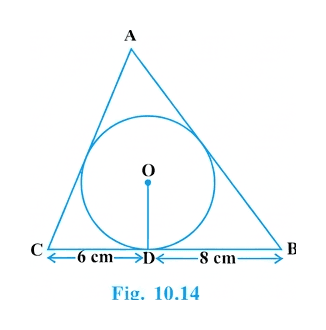
A triangle ABCABC is drawn to circumscribe a circle of radius 4 cm4 \text{ cm} such that the segments BDBD and DCDC into which BCBC is divided by the point of contact DD are of lengths 8 cm8 \text{ cm} and 6 cm6 \text{ cm} respectively (see Fig. 10.14). Find the sides ABAB and ACAC.

Question diagram 1
Check your answer with HomiSolve it yourself, then let Homi check your steps and spot mistakes.
Solution
Understand the Question
  • Tangents drawn from an external point to a circle are equal in length. This allows us to express all three side lengths of △ABC\triangle ABC in terms of an unknown tangent segment x=AE=AFx = AE = AF.
  • We can calculate the area of △ABC\triangle ABC in two independent ways:
    1. Using Heron's formula: Area=s(s−a)(s−b)(s−c)\text{Area} = \sqrt{s(s-a)(s-b)(s-c)}
    2. Splitting △ABC\triangle ABC into three smaller triangles (△OBC\triangle OBC, △OCA\triangle OCA, △OAB\triangle OAB) connected to the incentre OO, each having height equal to the inradius r=4 cmr = 4 \text{ cm}.
  • Equating both area expressions gives an equation in xx, which we solve to find ABAB and ACAC.

Step 1 · Express Side Lengths and Semi-perimeter in Terms of xx

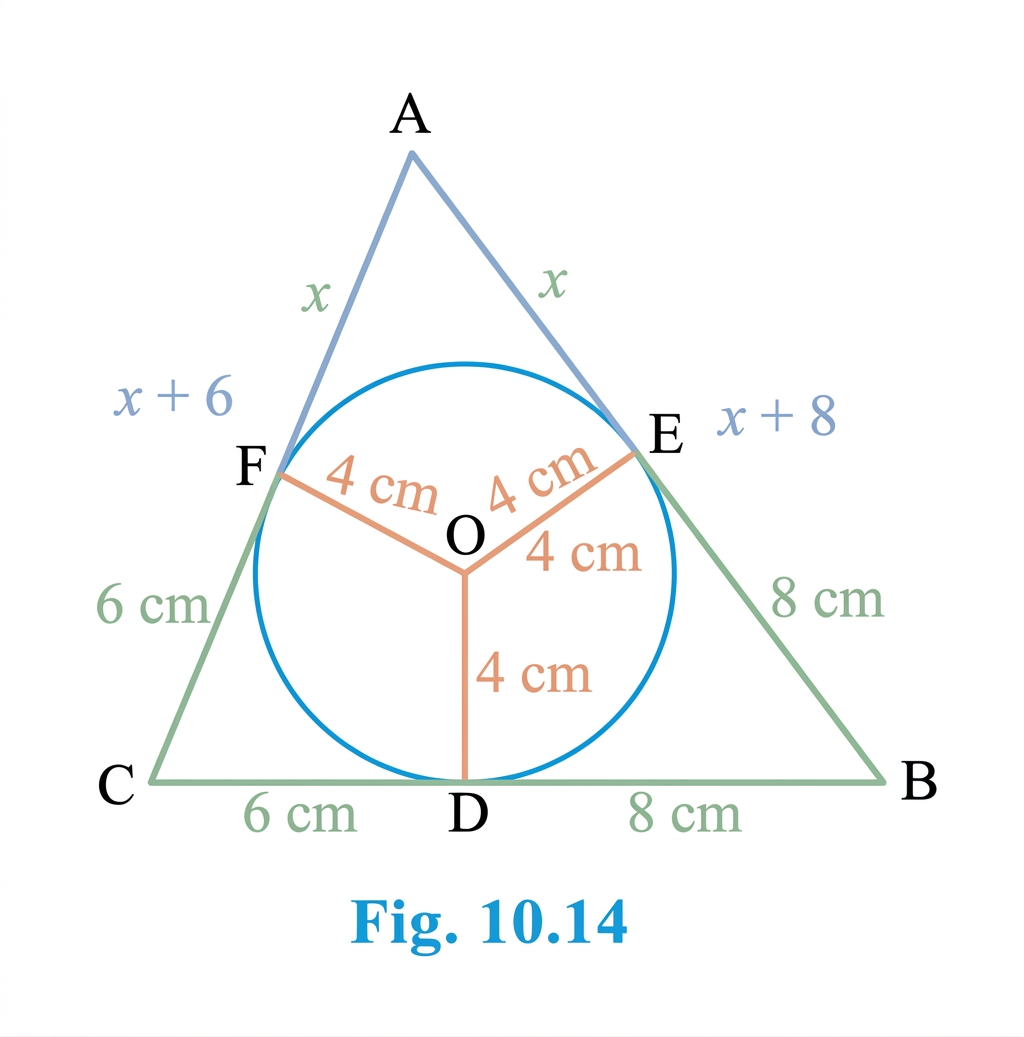
Let the incircle touch sides ABAB and ACAC at points EE and FF respectively.Diagram 1

Since tangents drawn from an external point to a circle are equal:

  • From point CC: CF=CD=6 cmCF = CD = 6 \text{ cm}
  • From point BB: BE=BD=8 cmBE = BD = 8 \text{ cm}
  • From point AA: let AF=AE=xAF = AE = x

The side lengths of △ABC\triangle ABC are:

BC=BD+DC=8+6=14 cmAB=AE+EB=x+8AC=AF+FC=x+6\begin{aligned} BC &= BD + DC = 8 + 6 = 14 \text{ cm} \\[0.6em] AB &= AE + EB = x + 8 \\[0.6em] AC &= AF + FC = x + 6 \end{aligned}

Semi-perimeter ss:

2s=AB+BC+AC2s=(x+8)+14+(x+6)2s=2x+28s=x+14\begin{aligned} 2s &= AB + BC + AC \\[0.6em] 2s &= (x + 8) + 14 + (x + 6) \\[0.6em] 2s &= 2x + 28 \\[0.6em] s &= x + 14 \end{aligned}

Step 2 · Find Area of △ABC\triangle ABC Using Heron's Formula

Using Heron's formula with a=14a = 14, b=x+6b = x + 6, c=x+8c = x + 8:

s−a=(x+14)−14=xs−b=(x+14)−(x+6)=8s−c=(x+14)−(x+8)=6\begin{aligned} s - a &= (x + 14) - 14 = x \\[0.6em] s - b &= (x + 14) - (x + 6) = 8 \\[0.6em] s - c &= (x + 14) - (x + 8) = 6 \end{aligned} Area(△ABC)=s(s−a)(s−b)(s−c)=(x+14)(x)(8)(6)=48x(x+14)\begin{aligned} \text{Area}(\triangle ABC) &= \sqrt{s(s-a)(s-b)(s-c)} \\[0.6em] &= \sqrt{(x+14)(x)(8)(6)} \\[0.6em] &= \sqrt{48x(x+14)} \end{aligned}

Step 3 · Find Area of △ABC\triangle ABC as Sum of Three Triangles

Join OAOA, OBOB, and OCOC. The perpendicular heights from incenter OO to each side are equal to the radius r=4 cmr = 4 \text{ cm}:

Area(△OBC)=12×BC×OD=12×14×4=28 cm2Area(△OCA)=12×AC×OF=12×(x+6)×4=2(x+6)=2x+12 cm2Area(△OAB)=12×AB×OE=12×(x+8)×4=2(x+8)=2x+16 cm2\begin{aligned} \text{Area}(\triangle OBC) &= \dfrac{1}{2} \times BC \times OD = \dfrac{1}{2} \times 14 \times 4 = 28 \text{ cm}^2 \\[0.6em] \text{Area}(\triangle OCA) &= \dfrac{1}{2} \times AC \times OF = \dfrac{1}{2} \times (x+6) \times 4 = 2(x+6) = 2x + 12 \text{ cm}^2 \\[0.6em] \text{Area}(\triangle OAB) &= \dfrac{1}{2} \times AB \times OE = \dfrac{1}{2} \times (x+8) \times 4 = 2(x+8) = 2x + 16 \text{ cm}^2 \end{aligned}

Summing the three areas:

Area(△ABC)=28+(2x+12)+(2x+16)=4x+56=4(x+14)\begin{aligned} \text{Area}(\triangle ABC) &= 28 + (2x + 12) + (2x + 16) \\[0.6em] &= 4x + 56 \\[0.6em] &= 4(x + 14) \end{aligned}

Step 4 · Equate Areas and Solve for xx

Equating the two area expressions: 48x(x+14)=4(x+14)\sqrt{48x(x+14)} = 4(x+14)

Squaring both sides:

48x(x+14)=16(x+14)23x(x+14)=(x+14)23x(x+14)−(x+14)2=0(x+14)[3x−(x+14)]=0(x+14)(2x−14)=0\begin{aligned} 48x(x+14) &= 16(x+14)^2 \\[0.6em] 3x(x+14) &= (x+14)^2 \\[0.6em] 3x(x+14) - (x+14)^2 &= 0 \\[0.6em] (x+14)[3x - (x+14)] &= 0 \\[0.6em] (x+14)(2x - 14) &= 0 \end{aligned}

This gives: x+14=0  ⟹  x=−14x + 14 = 0 \implies x = -14 2x−14=0  ⟹  x=72x - 14 = 0 \implies x = 7

Since side length cannot be negative, x=7 cmx = 7 \text{ cm}.

Step 5 · Calculate Sides ABAB and ACAC

Substitute x=7x = 7 into the side expressions:

AB=x+8=7+8=15 cmAC=x+6=7+6=13 cm\begin{aligned} AB &= x + 8 = 7 + 8 = 15 \text{ cm} \\[0.6em] AC &= x + 6 = 7 + 6 = 13 \text{ cm} \end{aligned}
Answer

AB=15 cmAB = 15 \text{ cm} and AC=13 cmAC = 13 \text{ cm}

Common Mistakes
  • Tangent Identification Error: Forgetting that CF=CD=6 cmCF = CD = 6\text{ cm} and BE=BD=8 cmBE = BD = 8\text{ cm}, which leads to incorrect side length representations.
  • Algebraic Cancellation: Dividing both sides by (x+14)(x+14) without justifying that x+14≠0x+14 \neq 0, or missing the negative root x=−14x = -14 (which must be formally rejected since side length >0> 0).
  • Radius as Height: Forgetting that the inradius r=4 cmr = 4\text{ cm} is perpendicular to all three sides, so it acts as the exact altitude for △OBC\triangle OBC, △OCA\triangle OCA, and △OAB\triangle OAB.

More questions in Exercise 10.2

Q1

In Q.1 to 3, choose the correct option and give justification.

  1. From a point QQ, the length of the tangent to a circle is 24 cm24\text{ cm} and the distance of QQ from the centre is 25 cm25\text{ cm}. The radius of the circle is (A) 7 cm7\text{ cm} (B) 12 cm12\text{ cm} (C) 15 cm15\text{ cm} (D) 24.5 cm24.5\text{ cm}
Q2

In Q.1 to 3, choose the correct option and give justification.

  1. In Fig. 10.11, if TP and TQ are the two tangents to a circle with centre O so that ∠POQ=110∘\angle \text{POQ} = 110^\circ, then ∠PTQ\angle \text{PTQ} is equal to (A) 60∘60^\circ (B) 70∘70^\circ (C) 80∘80^\circ (D) 90∘90^\circ
Q3

In Q.1 to 3, choose the correct option and give justification.

  1. If tangents PA and PB from a point P to a circle with centre O are inclined to each other at angle of 80∘80^\circ, then ∠POA\angle \text{POA} is equal to (A) 50∘50^\circ (B) 60∘60^\circ (C) 70∘70^\circ (D) 80∘80^\circ
Q4

Prove that the tangents drawn at the ends of a diameter of a circle are parallel.

Q5

Prove that the perpendicular at the point of contact to the tangent to a circle passes through the centre.

Q6

The length of a tangent from a point AA at distance 5 cm5\text{ cm} from the centre of the circle is 4 cm4\text{ cm}. Find the radius of the circle.

Q7

Two concentric circles are of radii 5 cm5 \text{ cm} and 3 cm3 \text{ cm}. Find the length of the chord of the larger circle which touches the smaller circle.

Q8

A quadrilateral ABCDABCD is drawn to circumscribe a circle (see Fig. 10.12). Prove that

AB+CD=AD+BC\text{AB} + \text{CD} = \text{AD} + \text{BC}

Q9

In Fig. 10.13, XYXY and X′Y′X'Y' are two parallel tangents to a circle with centre OO and another tangent ABAB with point of contact CC intersecting XYXY at AA and X′Y′X'Y' at BB. Prove that ∠AOB=90∘\angle AOB = 90^\circ.

Q10

Prove that the angle between the two tangents drawn from an external point to a circle is supplementary to the angle subtended by the line-segment joining the points of contact at the centre.

Q11

Prove that the parallelogram circumscribing a circle is a rhombus.

Q12

A triangle ABCABC is drawn to circumscribe a circle of radius 4 cm4 \text{ cm} such that the segments BDBD and DCDC into which BCBC is divided by the point of contact DD are of lengths 8 cm8 \text{ cm} and 6 cm6 \text{ cm} respectively (see Fig. 10.14). Find the sides ABAB and ACAC.

Q13

Prove that opposite sides of a quadrilateral circumscribing a circle subtend supplementary angles at the centre of the circle.

← Back to Circles