Triangles | Exercise 6.2

Question 4

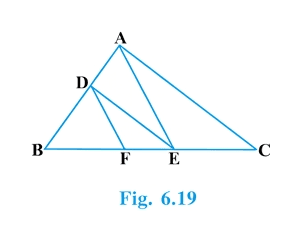
In Fig. 6.19, DE∥ACDE \parallel AC and DF∥AEDF \parallel AE. Prove that

BFFE=BEEC\dfrac{\text{BF}}{\text{FE}} = \dfrac{\text{BE}}{\text{EC}}

Question diagram 1
Check your answer with HomiSolve it yourself, then let Homi check your steps and spot mistakes.
Solution
Understand the Question
  • Basic Proportionality Theorem (BPT): If a line is drawn parallel to one side of a triangle intersecting the other two sides, it divides the two sides in the same ratio.
  • We apply BPT in two different triangles sharing side ABAB:
    1. In ΔABC\Delta ABC, since DE∥ACDE \parallel AC, it divides sides ABAB and BCBC in equal ratio.
    2. In ΔABE\Delta ABE, since DF∥AEDF \parallel AE, it divides sides ABAB and BEBE in equal ratio.
  • By equating the common ratio BDDA\dfrac{\text{BD}}{\text{DA}}, we arrive at the required proof.

Step 1 · Apply BPT in ΔABC\Delta ABC

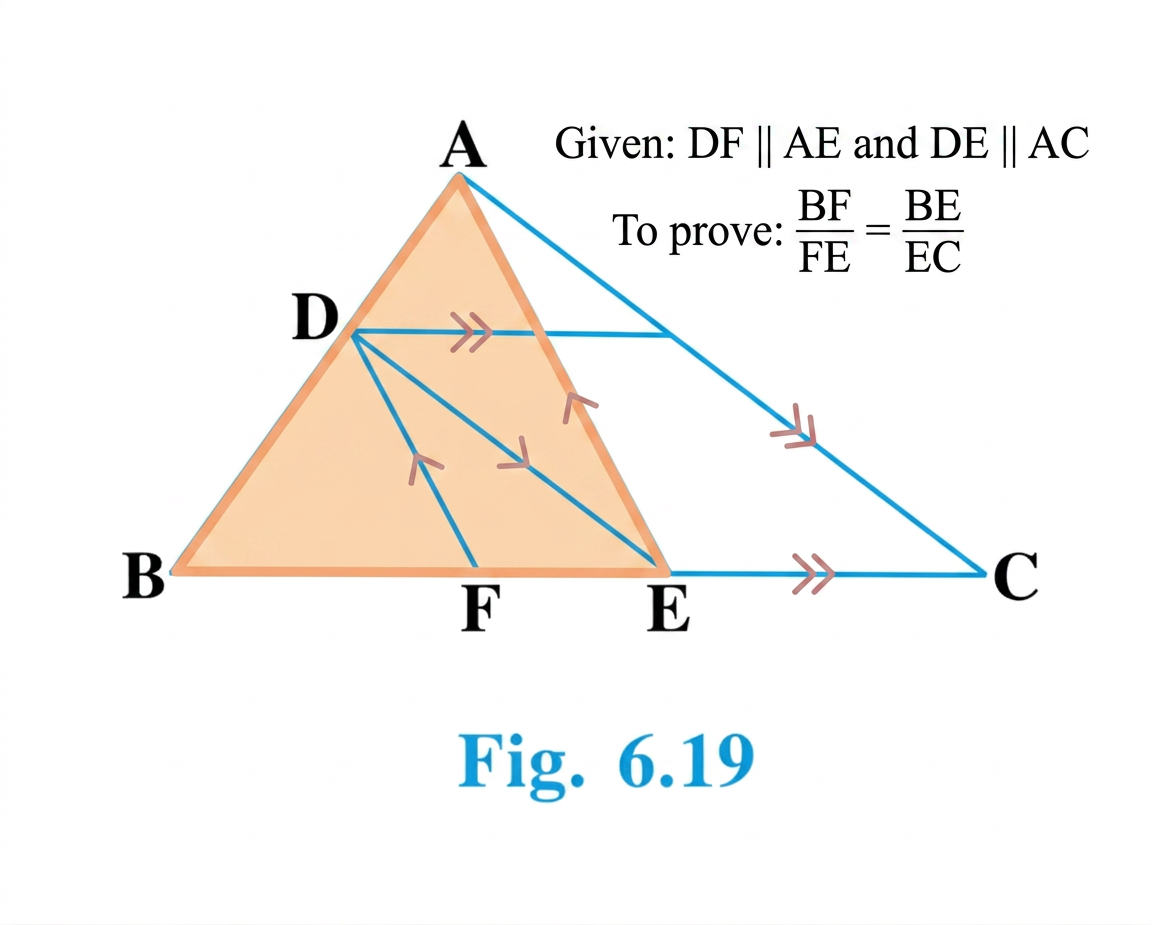
In ΔABC\Delta ABC, we are given DE∥ACDE \parallel AC.Diagram 1

By the Basic Proportionality Theorem (BPT) BDDA=BEEC…(1)\dfrac{\text{BD}}{\text{DA}} = \dfrac{\text{BE}}{\text{EC}} \quad \dots (1)

Step 2 · Apply BPT in ΔBAE\Delta BAE

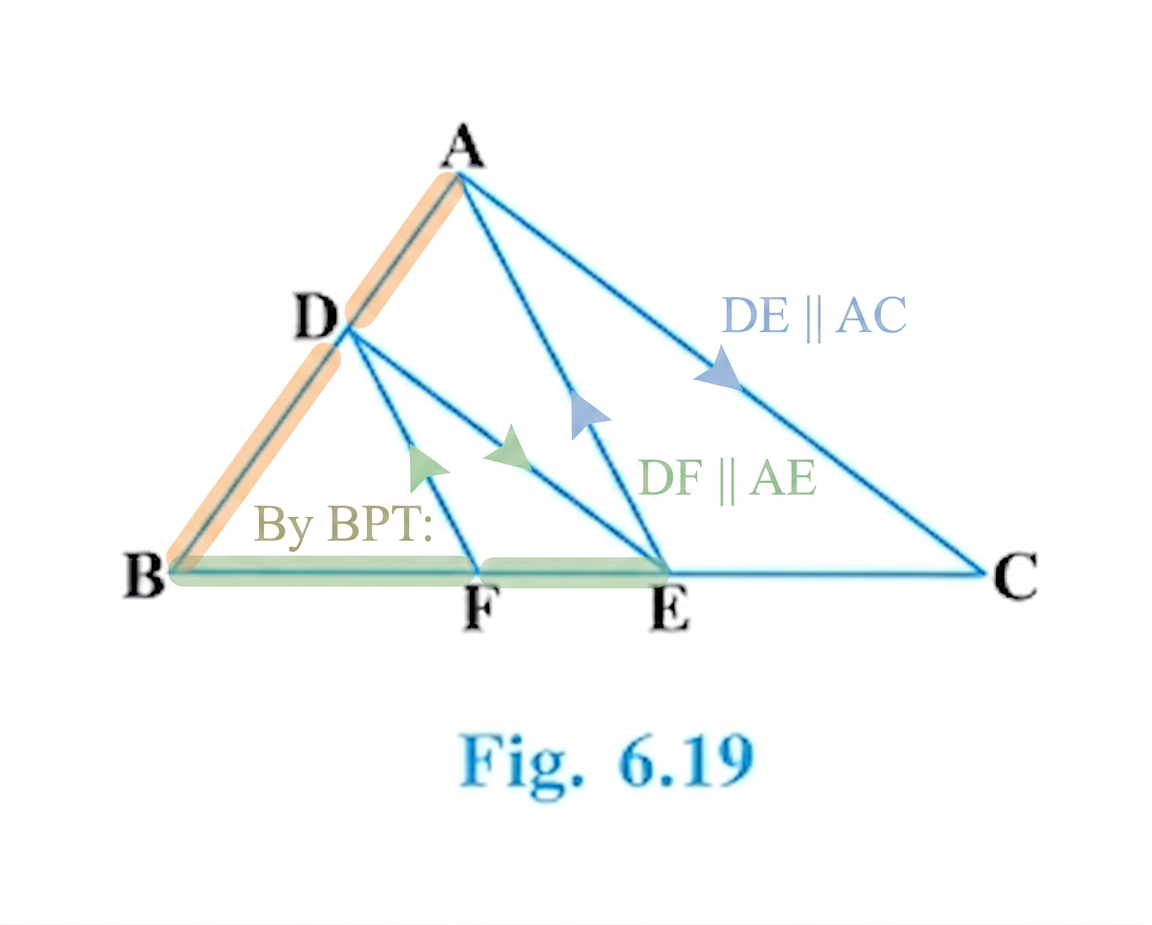
In ΔBAE\Delta BAE, we are given DF∥AEDF \parallel AE.Diagram 2

By the Basic Proportionality Theorem (BPT) BDDA=BFFE…(2)\dfrac{\text{BD}}{\text{DA}} = \dfrac{\text{BF}}{\text{FE}} \quad \dots (2)

Step 3 · Equate the Ratios

From equations (1)(1) and (2)(2), since both equal BDDA\dfrac{\text{BD}}{\text{DA}}

BFFE=BEEC\dfrac{\text{BF}}{\text{FE}} = \dfrac{\text{BE}}{\text{EC}}

Answer

Hence proved, BFFE=BEEC\dfrac{\text{BF}}{\text{FE}} = \dfrac{\text{BE}}{\text{EC}}

Common Mistakes
  • Choosing the Wrong Triangle: Applying DF∥AEDF \parallel AE to the entire ΔABC\Delta ABC instead of the smaller triangle ΔABE\Delta ABE.
  • Inconsistent Ratio Direction: Writing BDDA\dfrac{\text{BD}}{\text{DA}} on one side and ECBE\dfrac{\text{EC}}{\text{BE}} on the other. Always trace segments consistently starting from vertex BB.

More questions in Exercise 6.2

Q1

In Fig. 6.17, (i) and (ii), DE∥BCDE \parallel BC. Find ECEC in (i) and ADAD in (ii).

Q2

EE and FF are points on the sides PQPQ and PRPR respectively of a ΔPQR\Delta PQR. For each of the following cases, state whether EF∥QREF \parallel QR :

(i) PE=3.9 cmPE = 3.9\text{ cm}, EQ=3 cmEQ = 3\text{ cm}, PF=3.6 cmPF = 3.6\text{ cm}, and FR=2.4 cmFR = 2.4\text{ cm}

(ii) PE=4 cmPE = 4\text{ cm}, QE=4.5 cmQE = 4.5\text{ cm}, PF=8 cmPF = 8\text{ cm}, and RF=9 cmRF = 9\text{ cm}

(iii) PQ=1.28 cmPQ = 1.28\text{ cm}, PR=2.56 cmPR = 2.56\text{ cm}, PE=0.18 cmPE = 0.18\text{ cm}, and PF=0.36 cmPF = 0.36\text{ cm}

Q3

In Fig. 6.18, if LM∥CB\text{LM} \parallel \text{CB} and LN∥CD\text{LN} \parallel \text{CD}, prove that

AMAB=ANAD\dfrac{\text{AM}}{\text{AB}} = \dfrac{\text{AN}}{\text{AD}}

Q4

In Fig. 6.19, DE∥ACDE \parallel AC and DF∥AEDF \parallel AE. Prove that

BFFE=BEEC\dfrac{\text{BF}}{\text{FE}} = \dfrac{\text{BE}}{\text{EC}}

← Back to Triangles