Question 11
In Fig. 5.33, and . Find angles , ,
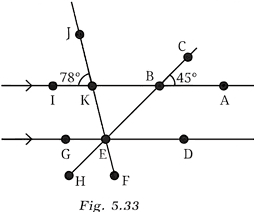
- We are given parallel lines intersected by two transversal lines, forming several angle relationships.
- Vertically opposite angles are equal at any intersection of two straight lines.
- Corresponding angles are equal when two parallel lines are cut by a transversal.
- The sum of all angles forming a straight line at a single point is .
- By finding and using angle relationships with parallel lines, we can determine the remaining angle on the straight line .
Step 1 · Find and Using Corresponding Angles
Given lines .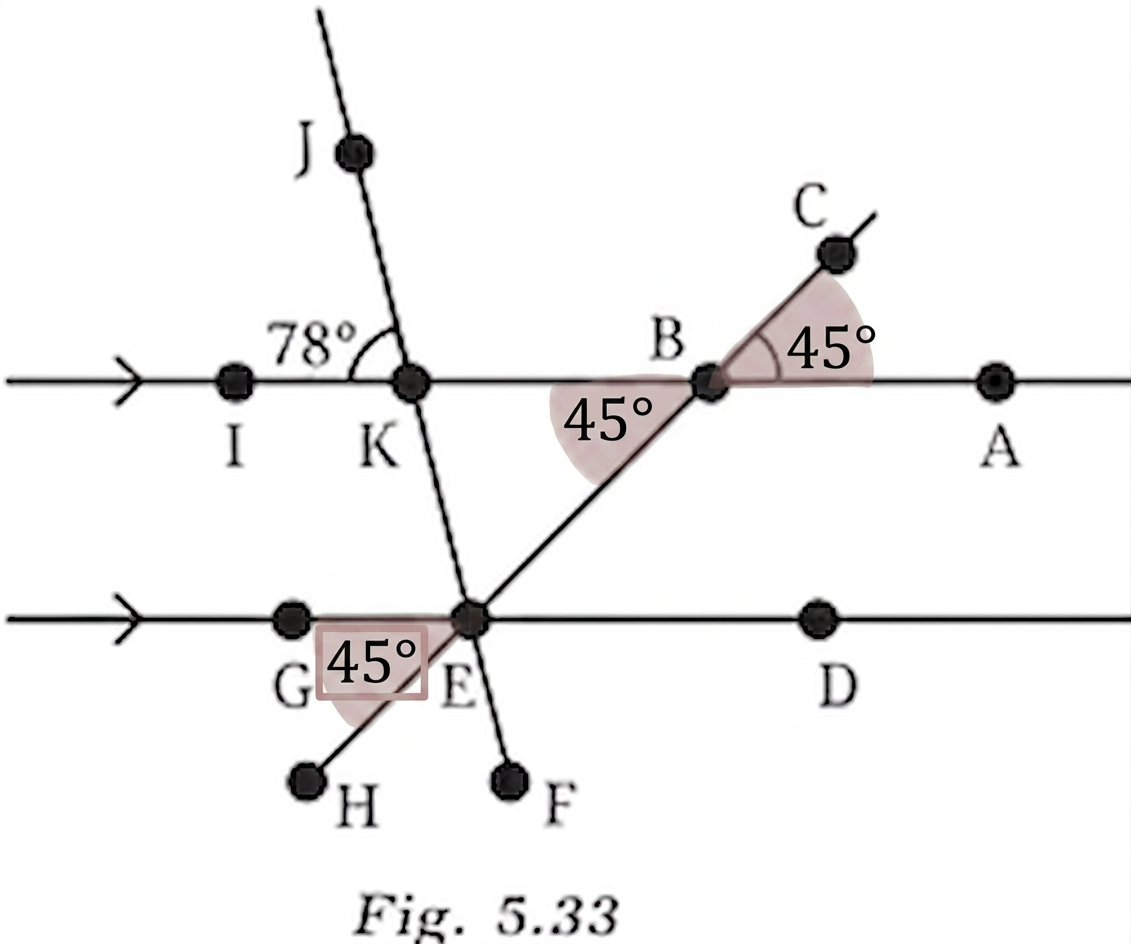
For transversal :
Since , corresponding angles are equal:
For transversal :
Since , corresponding angles are equal:
Step 2 · Find Using Straight Line Angle Sum
Angles , , and lie on the straight line .
Sum of angles on a straight line is :
, , and
- Misidentifying Angle Pairs: Confusing corresponding angles with alternate interior angles when identifying relations across parallel lines.
- Straight Line Sum Error: Forgetting that all three adjacent angles forming the straight line at point must add up to .
More questions in FIO
List all the linear pairs and vertically opposite angles you observe in Fig. 5.3:
Draw some lines perpendicular to the lines given on the dot paper in Fig. 5.10.
In Fig. 5.11, mark the parallel lines using the notation given above (single arrow, double arrow etc.). Mark the angle between perpendicular lines with a square symbol.
(a) How did you spot the perpendicular lines?
(b) How did you spot the parallel lines?
In the dot paper following, draw different sets of parallel lines. The line segments can be of different lengths but should have dots as endpoints.
Using your sense of how parallel lines look, try to draw lines parallel to the line segments on this dot paper.
(a) Did you find it challenging to draw some of them? (b) Which ones? (c) How did you do it?
In Fig. 5.13, which line is parallel to line — line or line ? How do you decide this?
Can you draw a line parallel to , that goes through point ? How will you do it with the tools from your geometry box? Describe your method.
Find the angles marked below.
Find the angle represented by .
In the figures below, what angles do and stand for?
In Fig. 5.33, and . Find angles , ,
In Fig. 5.34, is parallel to and is parallel to . Also, is perpendicular to . If , find the values of and .
What is the measure of angle in Fig. 5.35?
[Hint: Draw lines parallel to LM and PQ through points N and O.]