Question 5
Context: Let us check what quadrilateral we get if we draw the two diagonals such that their lengths are equal, they bisect each other and have an arbitrary angle, say , between them as shown in the figure to the right.
Q. Can you find all the remaining angles?
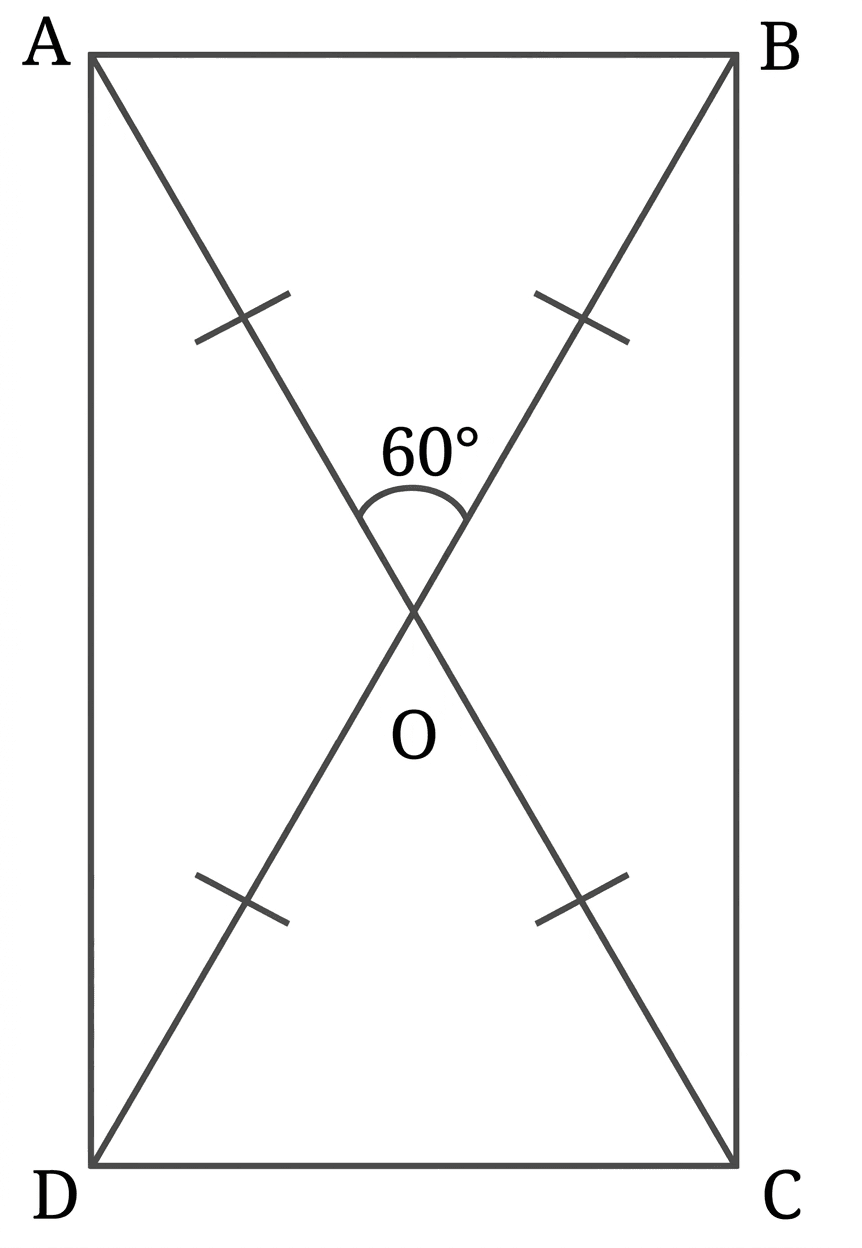
- A quadrilateral whose diagonals are equal in length and bisect each other is a rectangle.
- The diagonals of a rectangle are equal and bisect each other into four equal segments (), forming four isosceles triangles with the sides of the rectangle.
- Using properties of linear pairs, vertically opposite angles, and the angle sum property of triangles (), all remaining angles can be found.
Step 1 · Identify the Quadrilateral
Let the quadrilateral be with diagonals and intersecting at point .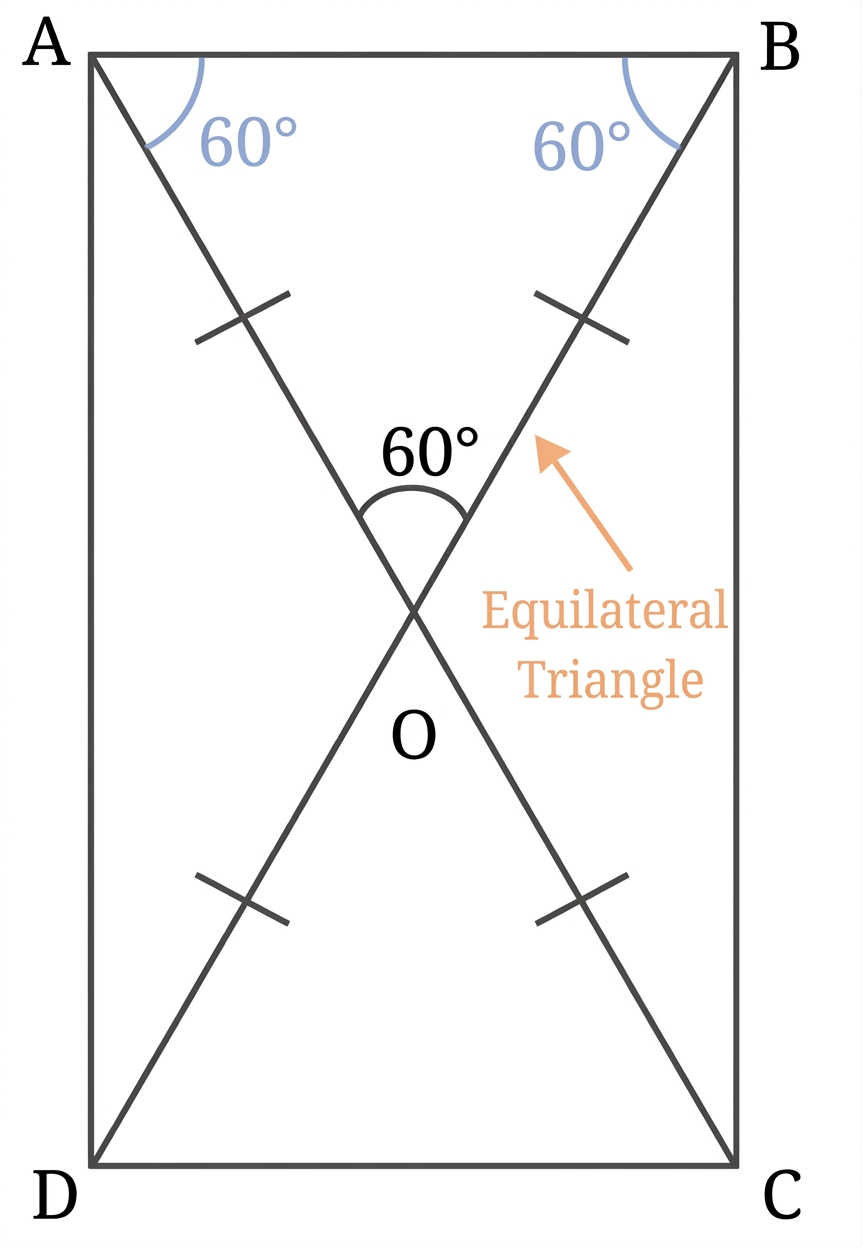
Given that the diagonals are equal and bisect each other:
A quadrilateral with diagonals that bisect each other is a parallelogram, and a parallelogram with equal diagonals is a rectangle. Therefore, is a rectangle.
Step 2 · Find Angles at Intersection Point
Given .
Vertically opposite angles are equal:
Angles and form a linear pair on line segment :
Vertically opposite to :
Step 3 · Find Angles in Triangles Formed by Diagonals
Since , the four triangles formed by the diagonals are isosceles triangles.
In ():
In ():
In ():
In ():
Step 4 · Verify Internal Angles of Rectangle
Since is a rectangle, each vertex angle is :
Angles at intersection :
Base angles of the triangles:
Angles of rectangle :
- Assuming Perpendicular Diagonals: Diagonals intersecting at form a rhombus or square; here the angle is given as , which confirms it is a non-square rectangle.
- Overlooking Equal Halves: Forgetting that in a rectangle, diagonals bisect each other into four equal segments (), meaning the opposite triangles are equilateral (angles ) and the adjacent triangles are isosceles (angles ).
More questions in IT
Observe the following figures.
Figs. (i), (ii), and (iii) are quadrilaterals, and the others are not. Why?
Are there other ways to define a rectangle?
A Carpenter's Problem
A carpenter needs to put together two thin strips of wood, as shown in Fig. 1, so that when a thread is passed through their endpoints, it forms a rectangle. She already has one 8 cm long strip. What should be the length of the other strip? Where should they both be joined?
Let us first model the structure that the carpenter has to make. The strips can be modelled as line segments. They are the diagonals of the quadrilateral formed by their endpoints. For the quadrilateral to be a rectangle, we need to answer the following questions —
- What is the length of the other diagonal?
- What is the point of intersection of the two diagonals?
- What should the angle be between the diagonals?
Can the following equalities be used to establish that ?
- (proved above)
- (vertically opposite angles)
Context: Let us check what quadrilateral we get if we draw the two diagonals such that their lengths are equal, they bisect each other and have an arbitrary angle, say , between them as shown in the figure to the right.
Q. Can you find all the remaining angles?
Context: In , since , the angles opposite them are equal, say .
Q. Can you find the value of ?
Can we now identify what type of quadrilateral ABCD is?
Notice that its angles all add up to ().
What can we say about its sides?
Will remain a rectangle if the angles between the diagonals are changed? Can we generalise this?
Take one of the angles between the diagonals as .
Context: We can compute the four angles between the diagonals to be , , , and .
Q. Can you find the other angles?
Context: Since we know that is isosceles, we can denote the measures of both of its base angles by .
Q. What is the value of (in degrees) in terms of ?
Context: Thus, all four angles of the quadrilateral are .
Q. What can we say about and , and and ?
In the earlier definition, we stated that a rectangle has (a) opposite sides of equal length, and (b) all angles equal to . Would we be wrong if we just define a rectangle as a quadrilateral in which all the angles are ?
If you think that this definition is incomplete, try constructing a quadrilateral in which the angles are all but the opposite sides are not equal.
Are you able to construct such a quadrilateral?
Is it wrong to write ? Why?
Can you similarly show that is parallel to ()?
In the quadrilaterals below, are there any non-rectangles?
Let us consider the Carpenter's Problem again. If the wooden strips have to be placed such that the thread passing through their endpoints forms a square, what must be done?
What more needs to be done to get equal sidelengths as well? Can this be achieved by properly choosing the angle between the diagonals? See if you can reason and/or experiment to figure this out!
Can this be used to find the angles and formed by the diagonals?
Context: The diagonals of a square are of equal lengths and bisect each other at right angles.
Q. Using this fact, construct a square with a diagonal of length .
Context: Since a square is a special type of rectangle, all the properties of a rectangle hold true for a square.
Q. Verify if this is true by going through geometric reasoning in Deduction 1 and Deduction 2, and see if they apply to a square as well.
Q. Similarly, find and .
4.2 Angles in a Quadrilateral
Is it possible to construct a quadrilateral with three angles equal to and the fourth angle not equal to ?
But why not?
Are there quadrilaterals that have parallel opposite sides that are not rectangles?
Construct such a figure by recalling how parallel lines can be constructed using a ruler and a set-square, or a compass and a ruler.
Context: Consider a parallelogram with adjacent sides of lengths and , and an angle of between them.
Q. What are the remaining angles of the parallelogram? What are the lengths of the remaining sides? See if you can reason out and/or experiment to figure these out.
Deduction 7— What can we say about the sides of a parallelogram?
By looking at a parallelogram, it appears that the opposite sides are equal. Can we again use congruence to show this? Which two triangles can be considered for this?
Is it wrong to write ? Why?
Are the diagonals of a parallelogram always equal? Check with the parallelogram that you have constructed.
Context: We see that the diagonals of a parallelogram need not be equal.
Q. Do they bisect each other (do they intersect at their midpoints)? Reason and/or experiment to figure this out.
Is it wrong to write ? Why?
Do the diagonals of a parallelogram intersect at a particular angle?
What are the other angles of the rhombus that we have constructed? Reason and/or experiment to figure this out.
It can be seen that (How?)
So a rhombus is a parallelogram, and a rectangle is also a parallelogram. How can this be represented using a Venn diagram?
Where will the set of squares occur in this diagram?
Are the diagonals of a rhombus equal?
Do the diagonals of a rhombus intersect at any particular angle? Reason out and/or experiment to figure this out!
In the rhombus GAME, we have (why?).
In the kite, show that the diagonal
(i) bisects and ,
(ii) bisects the diagonal , that is, , and is perpendicular to it.
Hint: Is ?
Construct a trapezium. Measure the base angles (marked in the figure).
Can you find the remaining angles without measuring them?
How do we construct an isosceles trapezium?
Construct an isosceles trapezium , with . Measure .
Now, it can be shown that . (How?)