Coordinate Geometry | Exercise 7.2

Question 10

Find the area of a rhombus if its vertices are (3,0)(3, 0), (4,5)(4, 5), (−1,4)(-1, 4) and (−2,−1)(-2, -1) taken in order.

[Hint : Area of a rhombus = 12\dfrac{1}{2} (product of its diagonals)]

Check your answer with HomiSolve it yourself, then let Homi check your steps and spot mistakes.
Solution
Understand the Question
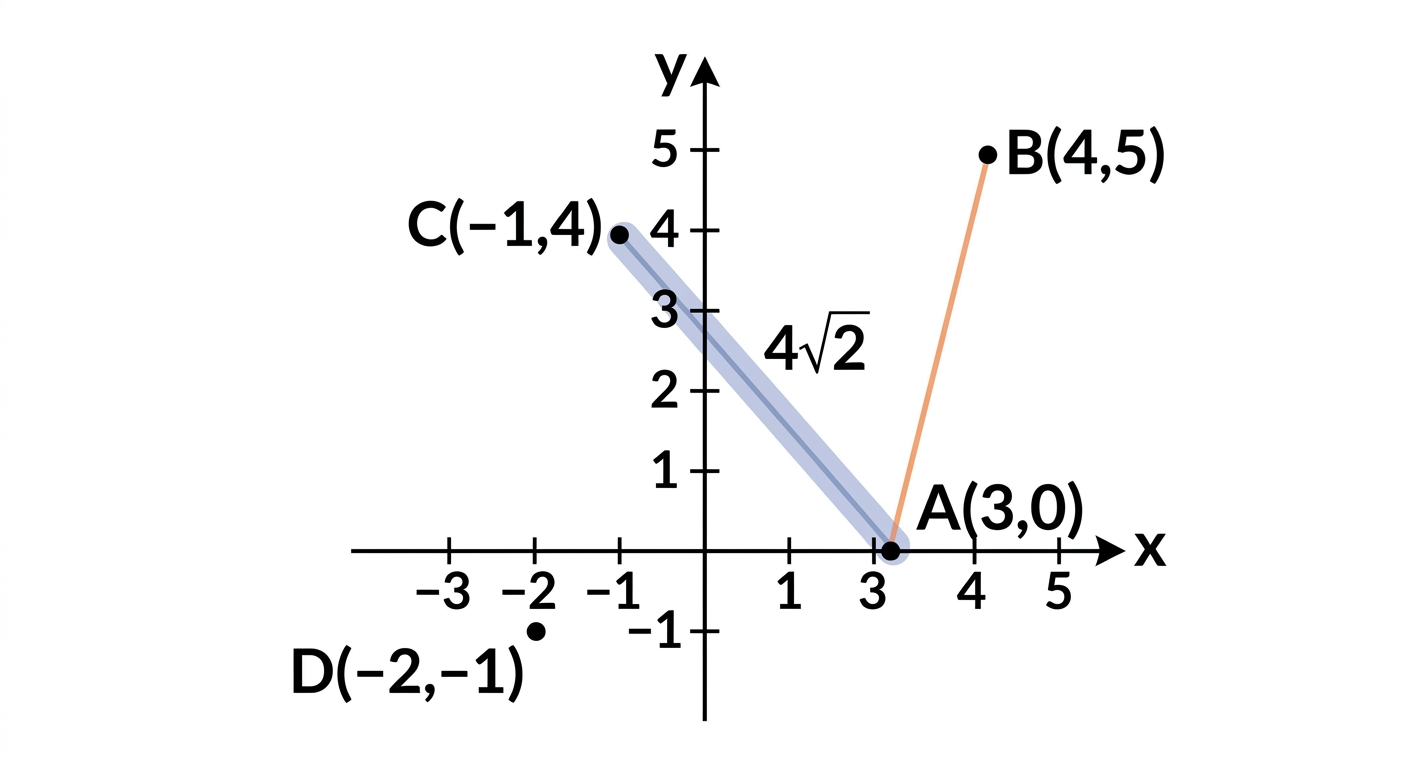
  • Let the given vertices taken in order be A(3,0)A(3, 0), B(4,5)B(4, 5), C(−1,4)C(-1, 4), and D(−2,−1)D(-2, -1).
  • The diagonals of the rhombus are the line segments connecting opposite vertices: ACAC and BDBD.
  • The area of a rhombus is given by: Area=12×d1×d2=12×AC×BD\text{Area} = \dfrac{1}{2} \times d_1 \times d_2 = \dfrac{1}{2} \times AC \times BD
  • We first calculate the lengths of diagonals ACAC and BDBD using the distance formula: d=(x2−x1)2+(y2−y1)2d = \sqrt{(x_2 - x_1)^2 + (y_2 - y_1)^2}

Step 1 · Find Length of Diagonal ACAC

Let the vertices be A(3,0)A(3, 0), B(4,5)B(4, 5), C(−1,4)C(-1, 4), and D(−2,−1)D(-2, -1).Diagram 1

Using the distance formula for A(3,0)A(3, 0) and C(−1,4)C(-1, 4):

AC=(−1−3)2+(4−0)2=(−4)2+(4)2=16+16=32=16×2=42 units\begin{aligned} \text{AC} &= \sqrt{(-1 - 3)^2 + (4 - 0)^2} \\ &= \sqrt{(-4)^2 + (4)^2} \\ &= \sqrt{16 + 16} \\ &= \sqrt{32} \\ &= \sqrt{16 \times 2} \\ &= 4\sqrt{2} \text{ units} \end{aligned}

Step 2 · Find Length of Diagonal BDBD

Using the distance formula for B(4,5)B(4, 5) and D(−2,−1)D(-2, -1):

BD=(−2−4)2+(−1−5)2=(−6)2+(−6)2=36+36=72=36×2=62 units\begin{aligned} \text{BD} &= \sqrt{(-2 - 4)^2 + (-1 - 5)^2} \\ &= \sqrt{(-6)^2 + (-6)^2} \\ &= \sqrt{36 + 36} \\ &= \sqrt{72} \\ &= \sqrt{36 \times 2} \\ &= 6\sqrt{2} \text{ units} \end{aligned}

Step 3 · Calculate Area of the Rhombus

Using the formula Area=12×d1×d2\text{Area} = \dfrac{1}{2} \times d_1 \times d_2:

Area=12×AC×BD=12×(42)×(62)=12×24×(2×2)=12×24×2=24 square units\begin{aligned} \text{Area} &= \dfrac{1}{2} \times \text{AC} \times \text{BD} \\[0.6em] &= \dfrac{1}{2} \times (4\sqrt{2}) \times (6\sqrt{2}) \\[0.6em] &= \dfrac{1}{2} \times 24 \times (\sqrt{2} \times \sqrt{2}) \\[0.6em] &= \dfrac{1}{2} \times 24 \times 2 \\[0.6em] &= 24 \text{ square units} \end{aligned}
Answer

24 square units24\text{ square units}

Common Mistakes
  • Choosing Adjacent Sides Instead of Diagonals: Diagonals connect opposite vertices (ACAC and BDBD), not adjacent ones (ABAB or BCBC).
  • Sign Errors in Distance Formula: Carefully handle negative coordinates inside parentheses, e.g., (−1−3)2=(−4)2=+16(-1 - 3)^2 = (-4)^2 = +16, not −16-16.
  • Simplifying Product of Radicals: Remember that 2×2=2\sqrt{2} \times \sqrt{2} = 2, so (42)(62)=24×2=48(4\sqrt{2})(6\sqrt{2}) = 24 \times 2 = 48.

More questions in Exercise 7.2

Q1

Find the coordinates of the point which divides the join of (−1,7)(-1, 7) and (4,−3)(4, -3) in the ratio 2:32 : 3.

Q2

Find the coordinates of the points of trisection of the line segment joining (4,−1)(4, -1) and (−2,−3)(-2, -3).

Q3

To conduct Sports Day activities, in your rectangular shaped school ground ABCDABCD, lines have been drawn with chalk powder at a distance of 1 m1\text{ m} each. 100100 flower pots have been placed at a distance of 1 m1\text{ m} from each other along ADAD, as shown in Fig. 7.12. Niharika runs 14th\dfrac{1}{4}\text{th} the distance ADAD on the 2nd line and posts a green flag. Preet runs 15th\dfrac{1}{5}\text{th} the distance ADAD on the eighth line and posts a red flag. What is the distance between both the flags? If Rashmi has to post a blue flag exactly halfway between the line segment joining the two flags, where should she post her flag?

Q4

Find the ratio in which the line segment joining the points (−3,10)(-3, 10) and (6,−8)(6, -8) is divided by (−1,6)(-1, 6).

Q5

Find the ratio in which the line segment joining A(1,−5)A(1, -5) and B(−4,5)B(-4, 5) is divided by the xx-axis. Also find the coordinates of the point of division.

Q6

If (1,2)(1, 2), (4,y)(4, y), (x,6)(x, 6) and (3,5)(3, 5) are the vertices of a parallelogram taken in order, find xx and yy.

Q7

Find the coordinates of a point A\text{A}, where AB\text{AB} is the diameter of a circle whose centre is (2,−3)(2, -3) and B\text{B} is (1,4)(1, 4).

Q8

If A and B are (−2,−2)(-2, -2) and (2,−4)(2, -4), respectively, find the coordinates of P such that AP=37AB\text{AP} = \dfrac{3}{7} \text{AB} and P lies on the line segment AB.

Q9

Find the coordinates of the points which divide the line segment joining A(−2,2)A(-2, 2) and B(2,8)B(2, 8) into four equal parts.

Q10

Find the area of a rhombus if its vertices are (3,0)(3, 0), (4,5)(4, 5), (−1,4)(-1, 4) and (−2,−1)(-2, -1) taken in order.

[Hint : Area of a rhombus = 12\dfrac{1}{2} (product of its diagonals)]

← Back to Coordinate Geometry