Introduction to Trigonometry | Exercise 8.2

Question 3

If tan⁡(A+B)=3\tan (A + B) = \sqrt{3} and tan⁡(A−B)=13\tan (A - B) = \dfrac{1}{\sqrt{3}}; 0∘<A+B≤90∘0^\circ < A + B \le 90^\circ; A>BA > B, find AA and BB.

Check your answer with HomiSolve it yourself, then let Homi check your steps and spot mistakes.
Solution
Understand the Question
  • Given trigonometric values for compound angles: tan⁡(A+B)=3\tan (A + B) = \sqrt{3} and tan⁡(A−B)=13\tan (A - B) = \dfrac{1}{\sqrt{3}}.
  • Using standard trigonometric values for acute angles ( 0∘<A+B≤90∘\,0^\circ < A+B \le 90^\circ):
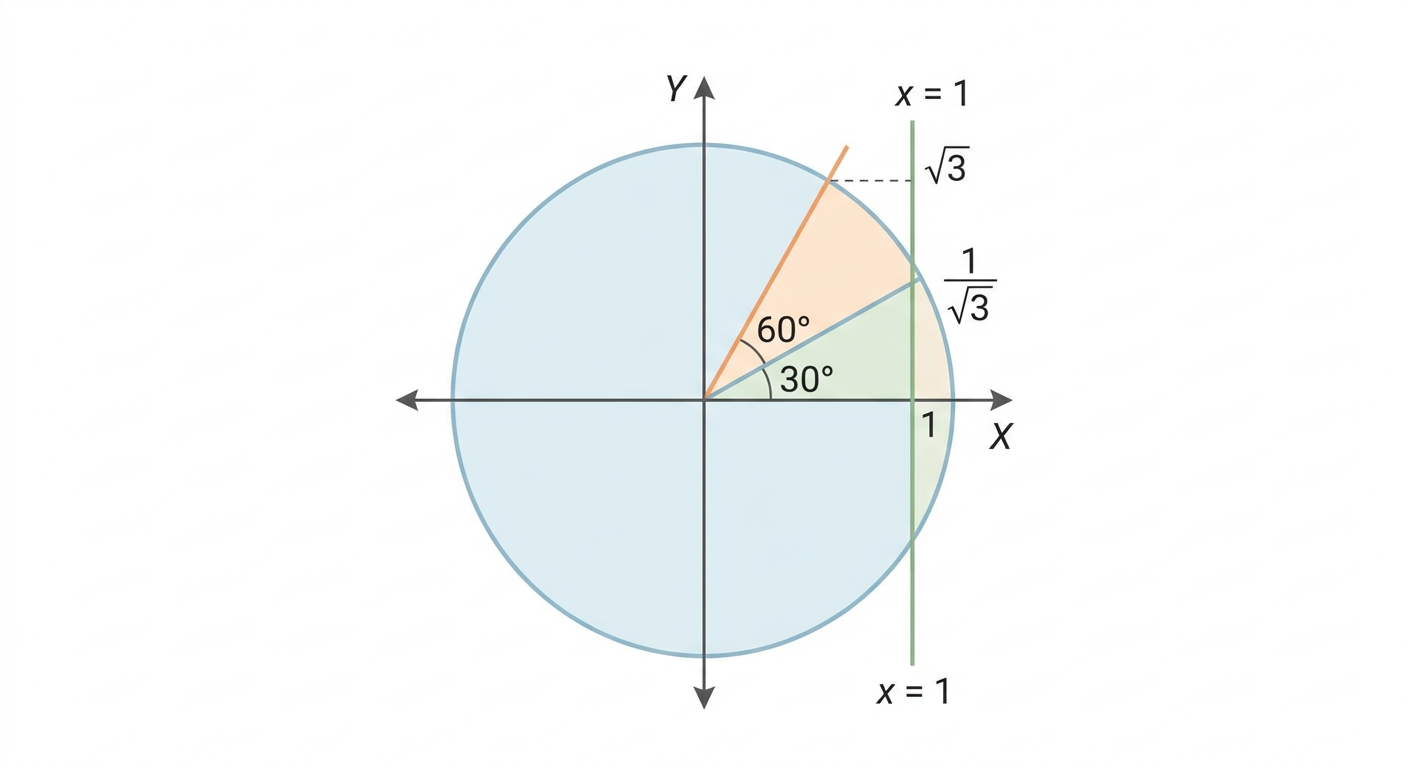
    • tan⁡60∘=3  ⟹  A+B=60∘\tan 60^\circ = \sqrt{3} \implies A + B = 60^\circ
    • tan⁡30∘=13  ⟹  A−B=30∘\tan 30^\circ = \dfrac{1}{\sqrt{3}} \implies A - B = 30^\circ
  • Solving this system of two linear equations simultaneously gives the individual values of AA and BB.

Step 1 · Form Linear Equations from Given Values

Given tan⁡(A+B)=3\tan (A + B) = \sqrt{3}

Since tan⁡60∘=3\tan 60^\circ = \sqrt{3} tan⁡(A+B)=tan⁡60∘  ⟹  A+B=60∘…(1)\tan (A + B) = \tan 60^\circ \implies A + B = 60^\circ \quad \dots (1)

Also given tan⁡(A−B)=13\tan (A - B) = \dfrac{1}{\sqrt{3}}

Since tan⁡30∘=13\tan 30^\circ = \dfrac{1}{\sqrt{3}} tan⁡(A−B)=tan⁡30∘  ⟹  A−B=30∘…(2)\tan (A - B) = \tan 30^\circ \implies A - B = 30^\circ \quad \dots (2)Diagram 1

Step 2 · Solve for AA and BB

Adding equations (1)(1) and (2)(2)

(A+B)+(A−B)=60∘+30∘2A=90∘A=90∘2=45∘\begin{aligned} (A + B) + (A - B) &= 60^\circ + 30^\circ \\[0.6em] 2A &= 90^\circ \\[0.6em] A &= \dfrac{90^\circ}{2} = 45^\circ \end{aligned}

Substitute A=45∘A = 45^\circ into equation (1)(1)

45∘+B=60∘B=60∘−45∘=15∘\begin{aligned} 45^\circ + B &= 60^\circ \\[0.6em] B &= 60^\circ - 45^\circ = 15^\circ \end{aligned}
Answer

A=45∘A = 45^\circ and B=15∘B = 15^\circ

Common Mistakes
  • Distributive Error: Assuming tan⁡(A+B)=tan⁡A+tan⁡B\tan(A + B) = \tan A + \tan B. Trigonometric ratios cannot be distributed over angle sums or differences.
  • Angle Value Swap: Mixing up standard values, such as writing tan⁡30∘=3\tan 30^\circ = \sqrt{3} and tan⁡60∘=13\tan 60^\circ = \dfrac{1}{\sqrt{3}}.
  • Condition Check: Always verify the constraints given: A+B=60∘A + B = 60^\circ satisfies 0∘<A+B≤90∘0^\circ < A + B \le 90^\circ, and A=45∘>B=15∘A = 45^\circ > B = 15^\circ satisfies A>BA > B.

More questions in Exercise 8.2

Q1

Evaluate the following :

(i) sin⁡60∘cos⁡30∘+sin⁡30∘cos⁡60∘\sin 60^\circ \cos 30^\circ + \sin 30^\circ \cos 60^\circ

(ii) 2tan⁡245∘+cos⁡230∘−sin⁡260∘2 \tan^2 45^\circ + \cos^2 30^\circ - \sin^2 60^\circ

(iii) cos⁡45∘sec⁡30∘+csc⁡30∘\dfrac{\cos 45^\circ}{\sec 30^\circ + \csc 30^\circ}

(iv) sin⁡30∘+tan⁡45∘−csc⁡60∘sec⁡30∘+cos⁡60∘+cot⁡45∘\dfrac{\sin 30^\circ + \tan 45^\circ - \csc 60^\circ}{\sec 30^\circ + \cos 60^\circ + \cot 45^\circ}

(v) 5cos⁡260∘+4sec⁡230∘−tan⁡245∘sin⁡230∘+cos⁡230∘\dfrac{5 \cos^2 60^\circ + 4 \sec^2 30^\circ - \tan^2 45^\circ}{\sin^2 30^\circ + \cos^2 30^\circ}

Q2

Choose the correct option and justify your choice :

(i) 2tan⁡30∘1+tan⁡230∘=\dfrac{2 \tan 30^\circ}{1 + \tan^2 30^\circ} = (A) sin⁡60∘\sin 60^\circ (B) cos⁡60∘\cos 60^\circ (C) tan⁡60∘\tan 60^\circ (D) sin⁡30∘\sin 30^\circ

(ii) 1−tan⁡245∘1+tan⁡245∘=\dfrac{1 - \tan^2 45^\circ}{1 + \tan^2 45^\circ} = (A) tan⁡90∘\tan 90^\circ (B) 11 (C) sin⁡45∘\sin 45^\circ (D) 00

(iii) sin⁡2A=2sin⁡A\sin 2A = 2 \sin A is true when A=A = (A) 0∘0^\circ (B) 30∘30^\circ (C) 45∘45^\circ (D) 60∘60^\circ

(iv) 2tan⁡30∘1−tan⁡230∘=\dfrac{2 \tan 30^\circ}{1 - \tan^2 30^\circ} = (A) cos⁡60∘\cos 60^\circ (B) sin⁡60∘\sin 60^\circ (C) tan⁡60∘\tan 60^\circ (D) sin⁡30∘\sin 30^\circ

Q3

If tan⁡(A+B)=3\tan (A + B) = \sqrt{3} and tan⁡(A−B)=13\tan (A - B) = \dfrac{1}{\sqrt{3}}; 0∘<A+B≤90∘0^\circ < A + B \le 90^\circ; A>BA > B, find AA and BB.

Q4

State whether the following are true or false. Justify your answer.

(i) sin⁡(A+B)=sin⁡A+sin⁡B\sin (A + B) = \sin A + \sin B.

(ii) The value of sin⁡θ\sin \theta increases as θ\theta increases.

(iii) The value of cos⁡θ\cos \theta increases as θ\theta increases.

(iv) sin⁡θ=cos⁡θ\sin \theta = \cos \theta for all values of θ\theta.

(v) cot⁡A\cot A is not defined for A=0∘A = 0^\circ.

← Back to Introduction to Trigonometry