Introduction to Trigonometry | Exercise 8.2

Question 4

State whether the following are true or false. Justify your answer.

(i) sin⁡(A+B)=sin⁡A+sin⁡B\sin (A + B) = \sin A + \sin B.

(ii) The value of sin⁡θ\sin \theta increases as θ\theta increases.

(iii) The value of cos⁡θ\cos \theta increases as θ\theta increases.

(iv) sin⁡θ=cos⁡θ\sin \theta = \cos \theta for all values of θ\theta.

(v) cot⁡A\cot A is not defined for A=0∘A = 0^\circ.

Check your answer with HomiSolve it yourself, then let Homi check your steps and spot mistakes.
Solution
Understand the Question
  • In trigonometry, trigonometric functions operate on angles as arguments, not as algebraic multipliers; thus, standard algebraic distributive laws do not apply directly to trigonometric functions.
  • For acute angles (0∘≤θ≤90∘0^\circ \le \theta \le 90^\circ):
    • sin⁡θ\sin \theta increases from 00 to 11.
    • cos⁡θ\cos \theta decreases from 11 to 00.
    • sin⁡θ=cos⁡θ\sin \theta = \cos \theta holds only at θ=45∘\theta = 45^\circ.
    • Trigonometric ratios involving division by zero (e.g., cot⁡0∘=cos⁡0∘sin⁡0∘=10\cot 0^\circ = \dfrac{\cos 0^\circ}{\sin 0^\circ} = \dfrac{1}{0}) are undefined.

(i) sin⁡(A+B)=sin⁡A+sin⁡B\sin (A + B) = \sin A + \sin B.

Step 1 · Test with Counterexample

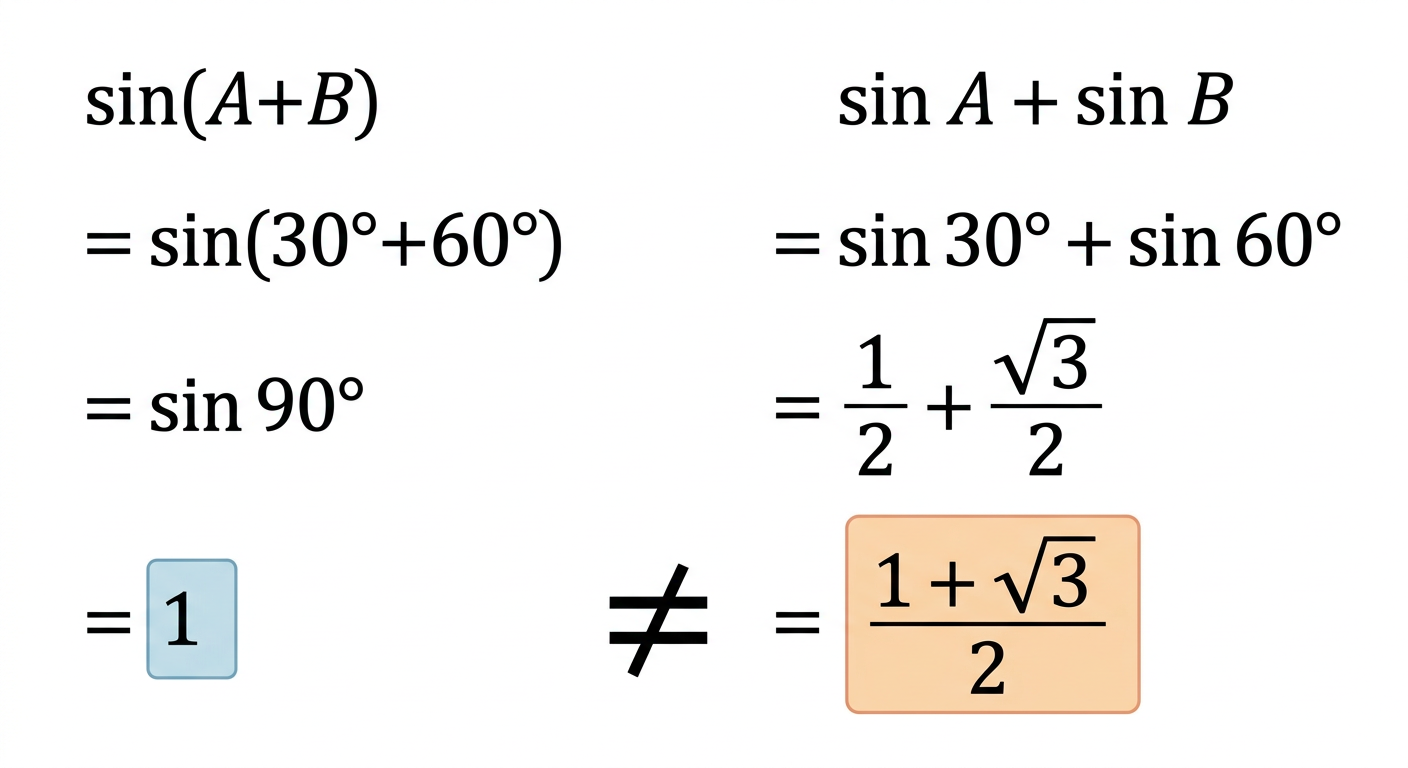
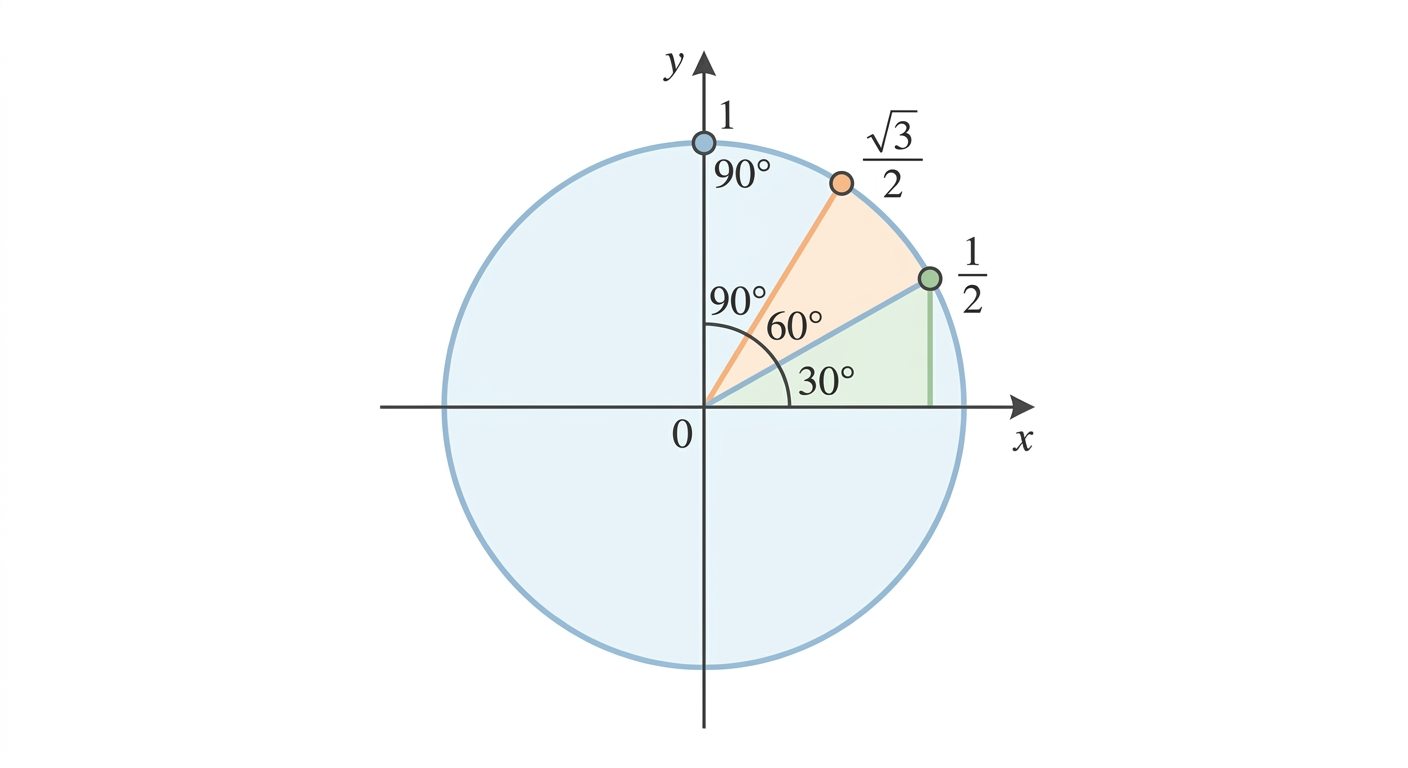
Let A=30∘A = 30^\circ and B=60∘B = 60^\circ.Diagram 1

Evaluating LHS

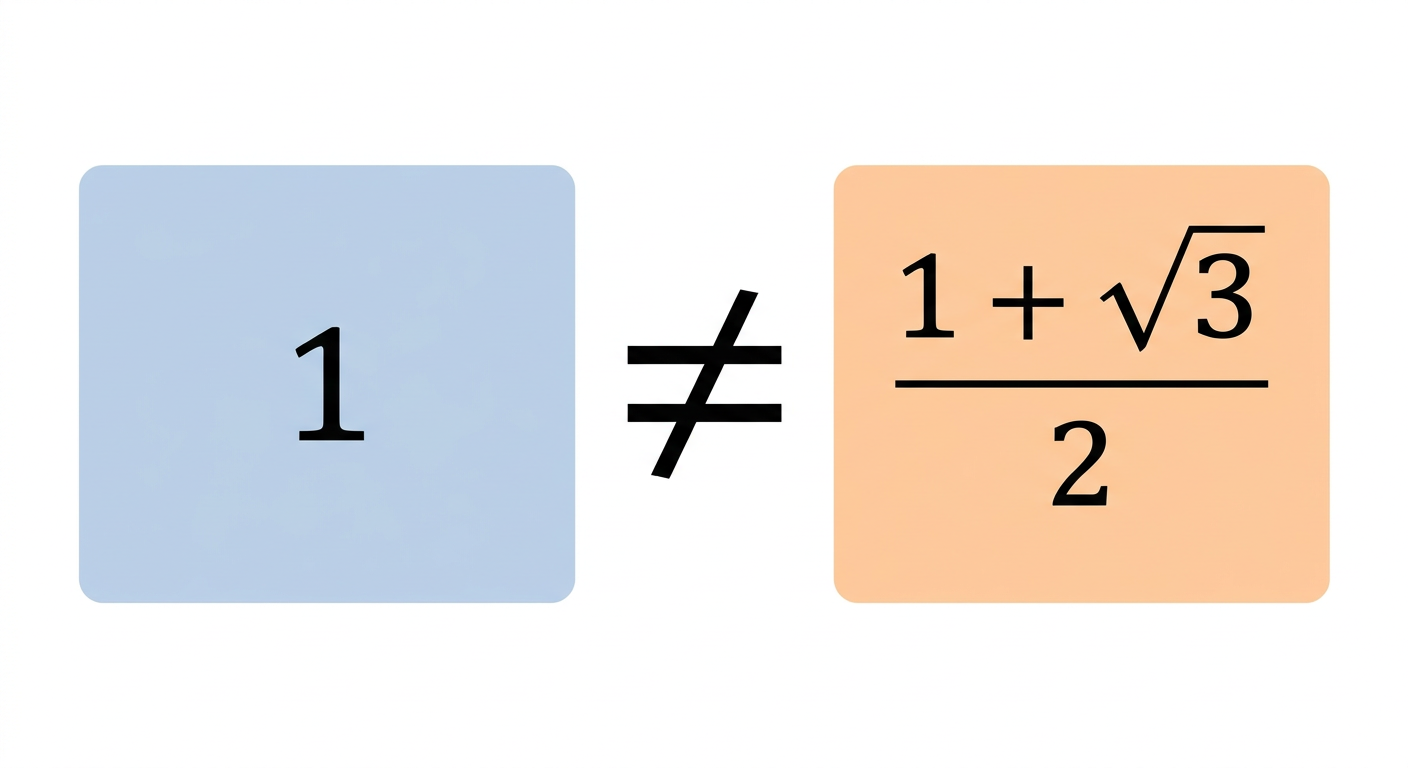
sin⁡(A+B)=sin⁡(30∘+60∘)=sin⁡90∘=1\begin{aligned} \sin (A + B) &= \sin (30^\circ + 60^\circ) \\[0.6em] &= \sin 90^\circ \\[0.6em] &= 1 \end{aligned}

Evaluating RHS

sin⁡A+sin⁡B=sin⁡30∘+sin⁡60∘=12+32=1+32\begin{aligned} \sin A + \sin B &= \sin 30^\circ + \sin 60^\circ \\[0.6em] &= \dfrac{1}{2} + \dfrac{\sqrt{3}}{2} \\[0.6em] &= \dfrac{1 + \sqrt{3}}{2} \end{aligned}

Since LHS≠RHS\text{LHS} \ne \text{RHS}, the statement is false.

Answer

(i) False

(ii) The value of sin⁡θ\sin \theta increases as θ\theta increases.

Step 1 · Evaluate Values of sin⁡θ\sin \theta

Evaluating sin⁡θ\sin \theta for standard angles in 0∘≤θ≤90∘0^\circ \le \theta \le 90^\circ:* sin⁡0∘=0\sin 0^\circ = 0

  • sin⁡30∘=12\sin 30^\circ = \dfrac{1}{2}
  • sin⁡45∘=12\sin 45^\circ = \dfrac{1}{\sqrt{2}}
  • sin⁡60∘=32\sin 60^\circ = \dfrac{\sqrt{3}}{2}
  • sin⁡90∘=1\sin 90^\circ = 1

Since 0<12<12<32<10 < \dfrac{1}{2} < \dfrac{1}{\sqrt{2}} < \dfrac{\sqrt{3}}{2} < 1, the value of sin⁡θ\sin \theta increases as θ\theta increases.

Answer

(ii) True

(iii) The value of cos⁡θ\cos \theta increases as θ\theta increases.

Step 1 · Evaluate Values of cos⁡θ\cos \theta

Evaluating cos⁡θ\cos \theta for standard angles in 0∘≤θ≤90∘0^\circ \le \theta \le 90^\circ:Diagram 3

  • cos⁡0∘=1\cos 0^\circ = 1
  • cos⁡30∘=32\cos 30^\circ = \dfrac{\sqrt{3}}{2}
  • cos⁡45∘=12\cos 45^\circ = \dfrac{1}{\sqrt{2}}
  • cos⁡60∘=12\cos 60^\circ = \dfrac{1}{2}
  • cos⁡90∘=0\cos 90^\circ = 0

Since 1>32>12>12>01 > \dfrac{\sqrt{3}}{2} > \dfrac{1}{\sqrt{2}} > \dfrac{1}{2} > 0, the value of cos⁡θ\cos \theta decreases as θ\theta increases.

Answer

(iii) False

(iv) sin⁡θ=cos⁡θ\sin \theta = \cos \theta for all values of θ\theta.

Step 1 · Test with Counterexample

Let θ=30∘\theta = 30^\circ.sin⁡30∘=12\sin 30^\circ = \dfrac{1}{2}

cos⁡30∘=32\cos 30^\circ = \dfrac{\sqrt{3}}{2}

Since sin⁡30∘≠cos⁡30∘\sin 30^\circ \ne \cos 30^\circ, the statement is not true for all values of θ\theta (it is only true for θ=45∘\theta = 45^\circ in 0∘≤θ≤90∘0^\circ \le \theta \le 90^\circ).

Answer

(iv) False

(v) cot⁡A\cot A is not defined for A=0∘A = 0^\circ.

Step 1 · Evaluate cot⁡0∘\cot 0^\circ

Using the quotient relation cot⁡A=cos⁡Asin⁡A\cot A = \dfrac{\cos A}{\sin A}:Diagram 5

For A=0∘A = 0^\circ

cot⁡0∘=cos⁡0∘sin⁡0∘=10\begin{aligned} \cot 0^\circ &= \dfrac{\cos 0^\circ}{\sin 0^\circ} \\[0.6em] &= \dfrac{1}{0} \end{aligned}

Division by zero is undefined, so cot⁡A\cot A is not defined for A=0∘A = 0^\circ.

Answer

(v) True

Common Mistakes
  • Distributive Property Fallacy: Treating sin⁡(A+B)\sin(A + B) as sin⁡×(A+B)=sin⁡A+sin⁡B\sin \times (A + B) = \sin A + \sin B. Trigonometric operators cannot be distributed over addition.
  • Opposing Trends of Sine and Cosine: Confusing the variation of sin⁡θ\sin \theta (which increases from 00 to 11) with cos⁡θ\cos \theta (which decreases from 11 to 00) in the first quadrant.
  • Generalizing a Single Match: Assuming sin⁡θ=cos⁡θ\sin \theta = \cos \theta holds generally simply because sin⁡45∘=cos⁡45∘\sin 45^\circ = \cos 45^\circ.
  • Zero in the Denominator: Forgetting that cot⁡0∘=cos⁡0∘sin⁡0∘=10\cot 0^\circ = \dfrac{\cos 0^\circ}{\sin 0^\circ} = \dfrac{1}{0}, which is undefined, not 00.

More questions in Exercise 8.2

Q1

Evaluate the following :

(i) sin⁡60∘cos⁡30∘+sin⁡30∘cos⁡60∘\sin 60^\circ \cos 30^\circ + \sin 30^\circ \cos 60^\circ

(ii) 2tan⁡245∘+cos⁡230∘−sin⁡260∘2 \tan^2 45^\circ + \cos^2 30^\circ - \sin^2 60^\circ

(iii) cos⁡45∘sec⁡30∘+csc⁡30∘\dfrac{\cos 45^\circ}{\sec 30^\circ + \csc 30^\circ}

(iv) sin⁡30∘+tan⁡45∘−csc⁡60∘sec⁡30∘+cos⁡60∘+cot⁡45∘\dfrac{\sin 30^\circ + \tan 45^\circ - \csc 60^\circ}{\sec 30^\circ + \cos 60^\circ + \cot 45^\circ}

(v) 5cos⁡260∘+4sec⁡230∘−tan⁡245∘sin⁡230∘+cos⁡230∘\dfrac{5 \cos^2 60^\circ + 4 \sec^2 30^\circ - \tan^2 45^\circ}{\sin^2 30^\circ + \cos^2 30^\circ}

Q2

Choose the correct option and justify your choice :

(i) 2tan⁡30∘1+tan⁡230∘=\dfrac{2 \tan 30^\circ}{1 + \tan^2 30^\circ} = (A) sin⁡60∘\sin 60^\circ (B) cos⁡60∘\cos 60^\circ (C) tan⁡60∘\tan 60^\circ (D) sin⁡30∘\sin 30^\circ

(ii) 1−tan⁡245∘1+tan⁡245∘=\dfrac{1 - \tan^2 45^\circ}{1 + \tan^2 45^\circ} = (A) tan⁡90∘\tan 90^\circ (B) 11 (C) sin⁡45∘\sin 45^\circ (D) 00

(iii) sin⁡2A=2sin⁡A\sin 2A = 2 \sin A is true when A=A = (A) 0∘0^\circ (B) 30∘30^\circ (C) 45∘45^\circ (D) 60∘60^\circ

(iv) 2tan⁡30∘1−tan⁡230∘=\dfrac{2 \tan 30^\circ}{1 - \tan^2 30^\circ} = (A) cos⁡60∘\cos 60^\circ (B) sin⁡60∘\sin 60^\circ (C) tan⁡60∘\tan 60^\circ (D) sin⁡30∘\sin 30^\circ

Q3

If tan⁡(A+B)=3\tan (A + B) = \sqrt{3} and tan⁡(A−B)=13\tan (A - B) = \dfrac{1}{\sqrt{3}}; 0∘<A+B≤90∘0^\circ < A + B \le 90^\circ; A>BA > B, find AA and BB.

Q4

State whether the following are true or false. Justify your answer.

(i) sin⁡(A+B)=sin⁡A+sin⁡B\sin (A + B) = \sin A + \sin B.

(ii) The value of sin⁡θ\sin \theta increases as θ\theta increases.

(iii) The value of cos⁡θ\cos \theta increases as θ\theta increases.

(iv) sin⁡θ=cos⁡θ\sin \theta = \cos \theta for all values of θ\theta.

(v) cot⁡A\cot A is not defined for A=0∘A = 0^\circ.

← Back to Introduction to Trigonometry